
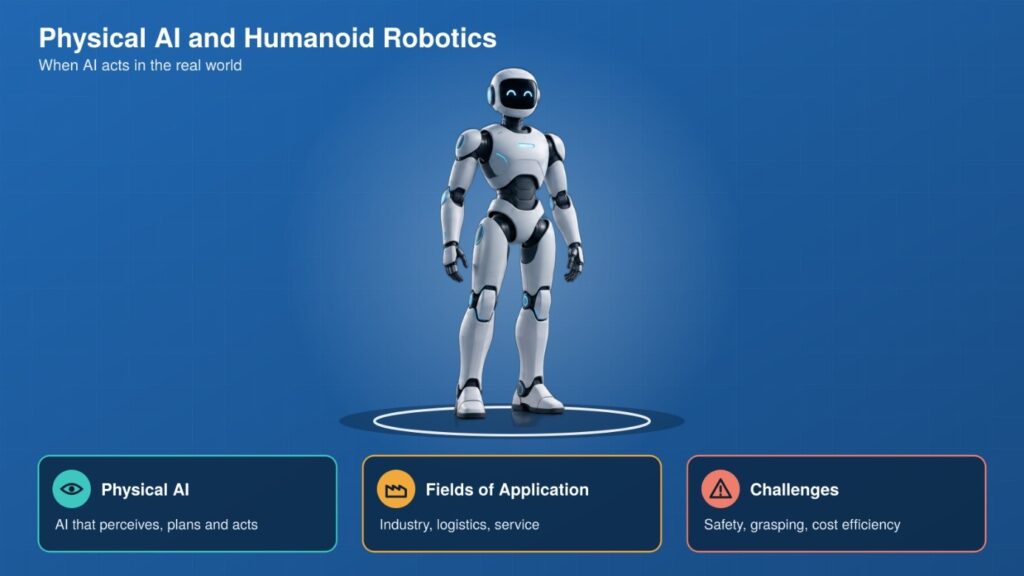
This is most evident in humanoid robots, which are being trialled in German factories for the first time in 2026. This article explains the technology behind physical AI, how far it has developed to date, and the challenges that still stand in the way of its widespread use.
What is physical AI?
The term “physical AI” refers to AI systems that can perceive their surroundings, derive actions from this perception, and carry out these actions in the real world using a machine. Examples include robots, automated guided vehicles and autonomous vehicles. The BMW Group defines it as the combination of digital AI with real machines and robots.
The difference from pure software AI lies in the consequences of an error. A language model can regenerate an answer as often as needed. By contrast, a robot cannot undo dropping a component. “Physical AI” therefore has to deal with gravity, friction, tolerances and time constraints – all quantities with which design engineers are familiar.
Technically, such a system works in a closed loop.
- Perceive: Cameras, force-torque sensors and joint encoders capture the surroundings and the robot’s own state.
- Understand and plan: AI models recognise objects, interpret the situation, and determine the next steps.
- Act: The controller translates the plan into joint movements and gripping forces.
- Feedback: The result feeds straight back into perception.
Conventional robot programmes only run through this loop within narrow, predefined limits. “Physical AI”, unlike conventional robot programs, is designed to close the loop even when a component is positioned differently than expected or a task is new.
How robots learn: models, simulation and digital twins
Three developments have made ‚physical AI‘ practicable today: large, pre-trained models, learning from demonstration, and training in simulation.
Vision-language-action models: These models can process camera images and spoken or written instructions simultaneously, producing motion commands directly. Consequently, robots no longer need to be programmed individually for every task. However, research also highlights the limitations of these models, which are often tied to a specific robot design and have limited access to robot data compared with text and image data.
Learning by demonstration: As training data is lacking, people demonstrate tasks to the robot via remote control. At Mercedes-Benz in Berlin-Marienfelde, for example, production-experienced employees have transferred their knowledge to the robot ‚Apollo‘ in this way.
Simulation and digital twin: Motion sequences can be practised virtually in thousands of different ways before being executed by a real robot. This method is faster, cheaper and safer. However, the quality of the transfer to the shop floor depends on the model: if the geometry, masses, friction coefficients and kinematics of the virtual plant do not match reality, the transfer fails. Experts refer to this as the ’sim-to-real‘ gap.
Humanoid robots: why the human form?
The strongest argument for human-centred design is the existing factory infrastructure. Stairs, doors, shelf heights, tools and workstations are all designed to accommodate humans. A robot with similar dimensions could work in this environment without any modifications being required. Fraunhofer IPA recognises the appeal of this: the combination of mobility and flexible gripping makes it possible to automate tasks in existing plants with minimal integration effort.
In a Fraunhofer IPA survey, industry representatives most frequently cited the following applications as useful:
- Material transport, such as moving boxes and containers
- Loading and unloading machines
- Gripping objects with complex shapes
The robot does not have to be entirely human-like to do this. In fact, 60% of respondents doubt that two legs are necessary, considering a mobile platform or a stationary dual-arm robot to be more practical. Practice confirms this: AEON, the robot being trialled at BMW in Leipzig, has a human-like upper body but moves on wheels.
“Humanoid” is therefore less a fixed design than a modular kit. The arms and hands follow the human model, while the base depends on the task. For tasks involving high cycle rates, heavy payloads or tight tolerances, the specialised industrial robot remains the faster, more precise and more economical option.
Status in 2026: from trade fair appearance to pilot operation
In 2026, humanoid robots are already in use in some plants, albeit mainly for pilot operations and specific tasks. The automotive industry is leading the way.
- BMW in Spartanburg (USA) deployed the robot Figure 02. This robot removed sheet metal parts in ten-hour shifts. It did this for ten months. It positioned the parts with millimeter precision. This was for the welding process. In total, it moved more than 90,000 components for over 30,000 vehicles.
- At BMW in Leipzig, the AEON robot from Hexagon Robotics is in use. It assists employees with the assembly of high-voltage batteries and component production. Following tests in April 2026, the pilot phase was scheduled for summer 2026.
- At Mercedes-Benz in Berlin-Marienfelde, the “Apollo” robot from Apptronik is being trialled. It is being trained to work autonomously. Its tasks include logistics and supporting activities on the production line.
- Schaeffler and the manufacturer Humanoid have announced a five-year partnership involving the delivery of several hundred robots to production sites.
The figures from Spartanburg demonstrate that a humanoid robot can perform a repeatable task over several months in a production environment. However, they also demonstrate the limitations: it was a single, clearly defined activity. Humanoid robots are still a long way from being able to take on any task.
Between progress and practical limits
There are four hurdles that still need to be cleared before it can be used more widely: safety, gripping technology, hardware maturity and economic viability.
Safety and standards: A conventional robot stops when the power is switched off. By contrast, a two-legged robot falls over. Weighing 70 kilograms or more, it poses a serious hazard to people nearby. The ISO 10218 standard assumes that robots cannot tip over. ISO 25785-1, which covers fall detection, controlled lowering, and behaviour during an emergency stop, aims to address this issue. However, at the beginning of 2026, it only existed as a working draft. Fraunhofer IPA therefore does not expect mixed operation with humans in initial deployments for the time being.
Gripping: The human hand is difficult to replicate. Fraunhofer IPA describes flexible hands as the biggest “bottleneck” at present.
Hardware maturity: According to the same analysis, actuators, gearboxes, batteries and sensors only partially meet industrial requirements in terms of robustness, service life and cost. Therefore, hardware has a greater influence on reliability and scalability than progress in AI models.
Economic viability: Around half of those surveyed by Fraunhofer IPA would pay up to €100,000 for a humanoid robot. However, the economic benefit is unclear, with inflated expectations being cited as one of the hurdles. In an early 2025 survey, 74% considered industrial use to be realistic within three to ten years.
Therefore, what matters is not what a robot can do in a trade fair video. What matters is how reliably, safely, and economically it can perform the same task in a three-shift operation.
What does this mean for engineering and design?
With physical AI, work shifts into the virtual world, where success or failure is determined by the quality of the engineering data. A robot that learns through simulation uses the CAD models of the plant, fixtures, and components to learn.
This creates three tasks for design and planning:
- Simulation-ready models: Geometry alone is not enough. Masses, centres of gravity, materials and kinematics must also be included.
- End-to-end data: The digital twin is only as up to date as the underlying data. Changes to components or plants must reliably reach the simulation via the PLM system.
- Robot-friendly design: Gripping surfaces, accessibility, and unambiguous position detection can be considered as early as the design phase, much like design for assembly.
Companies that cleanly organise their product and plant data today are laying the foundation for later automation, regardless of whether the task is ultimately taken on by a humanoid, a cobot or a conventional articulated robot.
Conclusion
Physical AI combines artificial intelligence with the ability to act in the real world. Humanoid robots are the most visible example of this technology, having now transitioned from trade fair exhibits to pilot operations.
However, before they can be used widely in industry, issues such as safety, gripping technology, hardware maturity and economic viability still need to be resolved. Therefore, the future of robotics does not necessarily lie in human-like machines. It lies in intelligent systems whose design and capabilities are tailored to specific tasks.
The benefit arises not only from the technology itself, but also from its seamless integration into products, processes and data.