
 Deutsch
Technical projects rarely fail because of the technology itself, but because they are not embraced in day-to-day work. New systems alter processes, roles and habits. This is precisely where change management comes in: it creates the conditions to ensure that changes are not only introduced, but also put into practice.
This is particularly crucial in CAD and PLM projects. Processes are complex, highly interconnected and have often evolved over many years. Establishing new structures in a sustainable manner is therefore a significant challenge.
Successful change management involves more than just communication or training. It is about involving users at an early stage, providing guidance and ensuring confidence in the practical application of the new systems.
Key success factors in change management
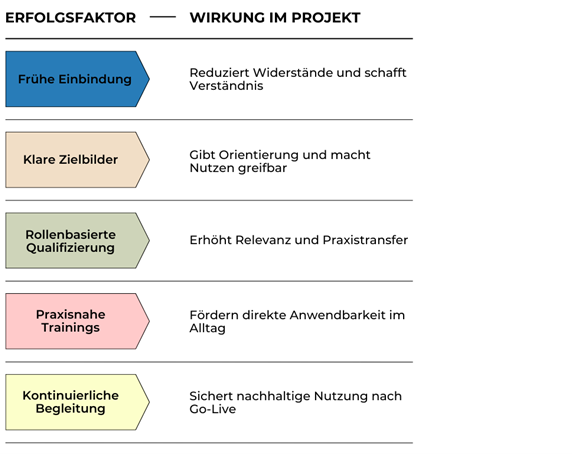
The overview shows that acceptance is not achieved through one-off measures, but through an ongoing process. A key factor here is how closely the training mirrors the real working environment. Users must not only understand why something is changing, but above all how they will actually work with it in practice.
A common driver of success is therefore the combination of change management and practical learning formats. Training sessions that replicate real-world processes, systems and roles play a key role in reducing uncertainty and building confidence in the new solution.
Conclusion
Change management is not merely a supporting process, but a key factor for success in technology projects.
Companies that actively foster acceptance lay the groundwork for ensuring that new systems are not only implemented but also used successfully