
 Deutsch

Industrial robots work quickly, precisely and without tiring – as long as everything goes according to plan. However, if components are positioned differently, variants change every hour or the environment changes, fixed processes reach their limits. This is precisely where artificial intelligence (AI) comes in: it helps robots to perceive their surroundings, assess situations and adapt their actions accordingly. This makes it possible to automate tasks that were previously considered too complex.
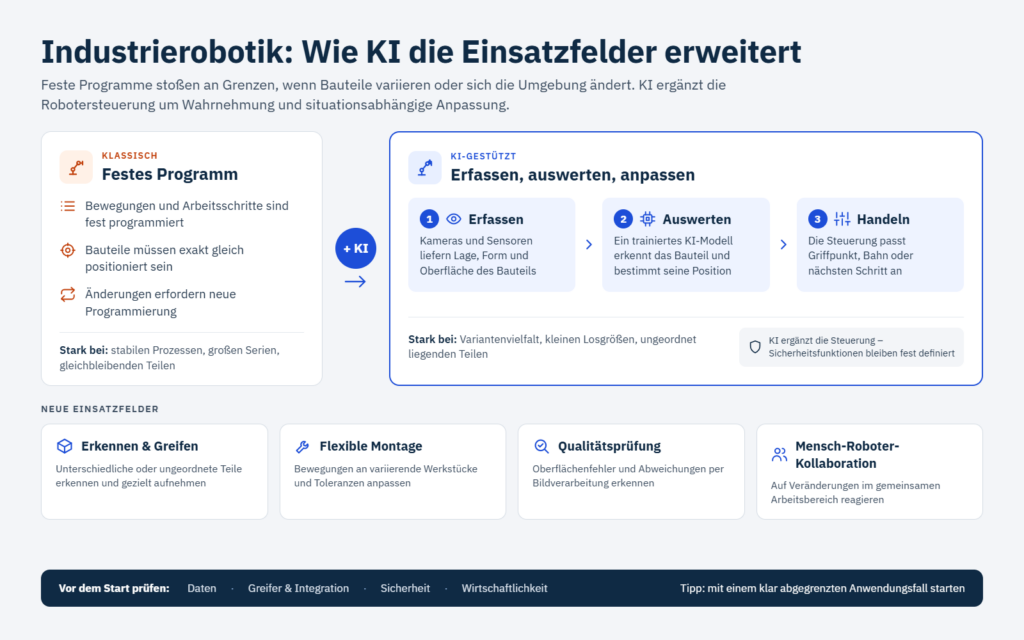
From fixed processes to flexible applications
Traditional industrial robots follow a fixed programme. Every movement and every step in the process is tailored to a specific task. This is highly efficient as long as the process remains stable and every component is located in exactly the same position.
AI complements this automation with perception and situation-dependent evaluation. The principle can be described in three steps:
- Detection: Cameras and sensors provide data on the position, shape or surface of a component.
- Evaluation: An AI system, such as a trained image-processing model, recognises the component and determines its position.
- Action: The robot controller uses this information to adjust the grip point, trajectory or next work step.
This makes it possible to automate tasks even where parts are arranged randomly, variants change or process conditions fluctuate.
It is important to note that AI-assisted robots do not act ‘freely’. The AI extends the existing control system; it does not replace it. Safety functions, workspace boundaries and process logic remain strictly defined.
Where AI opens up new fields of application
The combination of robotics, sensor technology and AI enables applications that would be difficult to implement using rigid processes, or would require a great deal of programming effort:
- Object recognition and gripping: The robot recognises different components or those lying in a disordered arrangement, determines their position and grips them precisely – right down to reaching into a box.
- Flexible assembly and handling: Movements adapt to varying workpieces, tolerances or changing process conditions.
- Quality inspection: AI-supported image processing detects surface defects and deviations, even when these are difficult to define in fixed inspection rules.
- Human-robot collaboration: Sensors and the analysis of environmental data help robotic systems to react to changes in the shared workspace.
These capabilities are particularly in demand wherever a wide variety of variants, small batch sizes or highly unpredictable conditions have previously hindered automation – for example, in assembly, machine feeding, order picking and sorting, as well as quality control.
What companies should bear in mind during implementation
AI does not automatically make a robot flexible or cost-effective. The key factor is whether the technology is suited to the specific production task. Before embarking on a project, it is worth considering four points:
- Data: Can the relevant information be reliably captured – even in the face of changing lighting conditions, reflections or dirt? Is there sufficient sample data available for training and testing?
- Technology: Are the grippers, camera and sensors suitable for the variety of components? Can the AI system be integrated seamlessly into the existing plant control system?
- Safety: The requirements for machine and occupational safety remain unchanged. A thorough risk assessment is essential, particularly in human-robot collaboration.
- Cost-effectiveness: Which process steps actually improve? How often do components or procedures change? And what is the effort involved in integrating, commissioning, maintaining and updating the AI models?
A good starting point is a clearly defined use case with a measurable objective, such as a higher grip success rate or less manual rework. This allows the potential and limitations to be realistically assessed before the solution is scaled up.
Conclusion
AI brings one key benefit to industrial robotics above all else: flexibility. Robots utilise information from their surroundings, handle a variety of workpieces and perform tasks that were previously hardly viable to automate using fixed programmes. This opens up new possibilities, particularly in high-variety manufacturing. The key lies in deploying AI specifically where it measurably improves a particular process.