
 Deutsch
Digital learning formats have become an integral part of technical training and continuing education, especially in complex areas such as CAD and PLM. In addition to the umbrella term e-learning, companies often encounter two formats: computer-based training (CBT) and web-based training (WBT).
Both aim to impart knowledge efficiently, but differ significantly in terms of technical implementation, flexibility, and their use in everyday project work. Especially when introducing new systems, releases, or processes, the key question is: Which learning format is suitable for which application?
Basics: What are CBT and WBT?
Computer-based training (CBT) and web-based training (WBT) are two established forms of digital learning that differ primarily in their technical delivery.
Computer-based training is used locally on a computer or within a closed IT environment. The learning content is pre-installed or available via an internal network and works independently of an internet connection.
Web-based training, on the other hand, is delivered via a web browser and is internet or intranet-based. The content is managed centrally and can be updated or expanded at any time. Learners can access the modules anytime, anywhere, often supplemented by interactive elements, exercises, and learning progress assessments.
Direct comparison of CBT and WBT
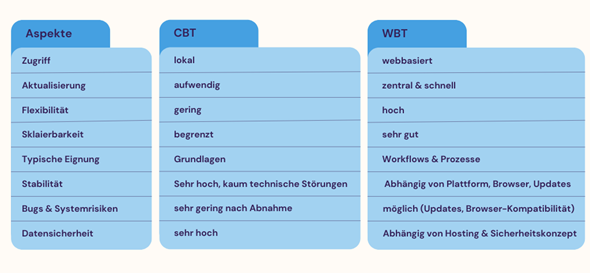
Both learning formats have clear strengths, but also specific limitations. The choice between them depends heavily on the requirements for content, timeliness, security, and flexibility.
Computer-based training (CBT) is particularly impressive in terms of stability and security. Since the content is operated locally and in a controlled manner, technical malfunctions rarely occur after acceptance. However, changes or updates are more complex, which limits flexibility. CBT is therefore particularly suitable when learning content remains stable over the long term, sensitive data must be protected, or standardized basics are to be taught.
Web-based training (WBT), on the other hand, scores points for its timeliness, scalability, and adaptability. Content can be quickly updated and made accessible to different roles or target groups. At the same time, the success of WBT depends more heavily on technical conditions such as platform, browser, updates, and hosting, which requires organizational and technical planning. WBT is particularly suitable when content needs to be regularly adapted, different target groups need to be trained, or distributed teams and international locations are involved.
In short:
- CBT stands for control and stability.
- WBT stands for flexibility and dynamism.
Practical experience in the CAD/PLM environment: Why WBT is often the better choice
In the practical implementation of CAD and PLM projects, requirements change regularly: new software releases, adapted workflows, company-specific processes, or new role models. This is precisely where traditional CBTs quickly reach their limits.
Web-based training offers the flexibility needed to continuously adapt learning content to real workflows. Modern WBT concepts rely on workflow-based scenarios, real CAD and PLM models, role-based learning paths, and integrated exercises and knowledge checks. This allows learners to not only acquire theoretical knowledge, but also develop skills that can be directly applied to their everyday work.
CBTs nevertheless retain their validity, for example for stable foundations, standardized content, or training in isolated IT environments. In many projects, a targeted combination of both formats has therefore proven successful.
Conclusion
CBT and WBT are not opposites, but complementary learning formats.
- CBTs are suitable for stable, safety-relevant, and standardized content.
- WBTs are ideal for dynamic, process-oriented, and role-based training.
Companies that consistently align their e-learning strategy with the use case and combine both formats in a meaningful way create the basis for sustainable skills development and the successful use of complex CAD and PLM systems.