
 Deutsch
From 2 to 4 September 2026, the 28th International Conference on Engineering and Product Design Education (E&PDE 2026) took place at the University of Bristol, UK.
ARTECH Consulting GmbH was also represented with an expert paper. A presentation entitled ‘Adapting Guideline-Based Engineering Training for Culturally Diverse Teams: Insights from Industrial CAD/PLM Transitions’ was given.
The paper addresses a significant challenge in the context of international CAD/PLM transformations: the establishment of common modelling standards, processes and working practices across different sites. At the same time, international engineering teams comprise individuals with different professional experiences, educational backgrounds, and approaches to rules and problem solving.
Shared standards – different ways of engaging
Technical guidelines are an important tool for establishing a shared understanding of processes, modelling conventions, and quality requirements during CAD/PLM transformations. However, this study shows that practitioners do not necessarily interpret and use identical guidelines in the same way.
Within the industrial CAD/PLM transition examined in the study, two modes of engagement with the guidelines emerged as particularly productive. Some users preferred clear, explicit, step-by-step instructions, treating the guidelines as an authoritative reference. Others regarded the same guidelines as a flexible framework to be combined with professional experience and the specific application context.
Importantly, neither approach was considered superior. Both could support effective learning when users were given the opportunity to ask questions, clarify meanings, discuss exceptional cases, and reflect on how a guideline should be applied in practice.
Guidelines as mediating learning tools
One of the central conclusions of the work is therefore that guidelines should not be understood solely as static collections of instructions.
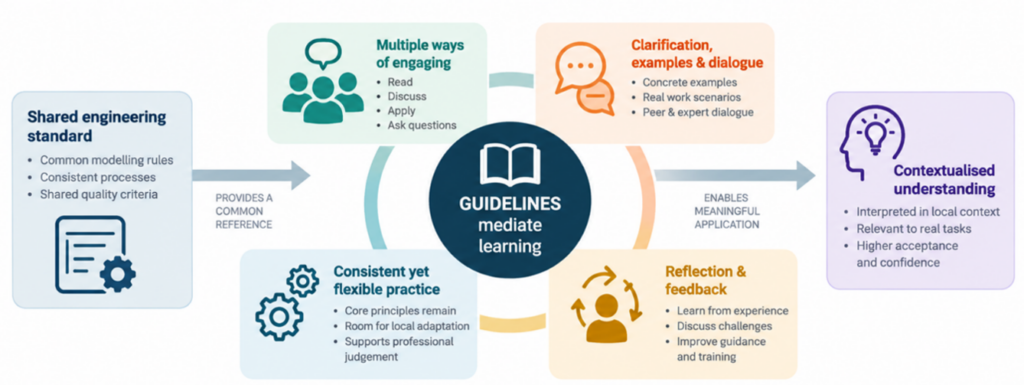
Instead, they can act as mediating learning tools. They provide a common reference framework while also creating a basis for clarification, discussion and reflection. Through this interaction, users can connect shared engineering standards with real engineering activities and their own professional context.
This approach can be particularly helpful in culturally and professionally diverse teams, combining the need for standardisation with the flexibility required for local conditions and professional judgement.
From standardisation to contextualised understanding
Based on the findings, the study proposes a culturally responsive, guideline-based learning framework.
This framework begins with a shared engineering standard and acknowledges that users may interact with it in various ways. Assumptions are made explicit through clarification, examples and dialogue, while reflection and feedback support learning from experience. The objective is to develop a contextualised understanding in which the core principles remain consistent, while allowing for professional judgement and local adaptation.
Relevance for industrial practice
The findings of international CAD/PLM projects indicate that successful standardisation cannot be achieved through technical documentation alone. It is equally important to consider how guidelines are communicated, discussed, and applied to specific engineering contexts.
This connects two areas that are particularly relevant to ARTECH: successfully implementing CAD/PLM transformations and practice-oriented engineering team qualification.
The central message of this study is that: Standardisation and inclusion are not opposites. Shared engineering standards can coexist with different approaches to learning and reasoning when interpretation, dialogue and reflection are deliberately incorporated into the learning process.
The full scientific paper is available via the Design Society with the DOI: 10.35199/EPDE.2026.80.