
 Deutsch
This article is Part 2 of our series on hybrid learning in engineering. In Part 1, we examined the fundamentals, strengths and limitations of digital training formats – from e-learning and CATIA V5 training courses to scalable PLM training programmes. We can build on that here.
Digital formats scale up. Face-to-face training provides a solid foundation. But what happens if you combine the two in the wrong way? Then you don’t create added value – just friction. Too much face-to-face training for content that works just as well online. Or e-learning modules for complex engineering situations that require real interaction and feedback from a trainer.
The art of hybrid learning does not lie in simply offering both – but in knowing when each format produces the greatest learning impact. That is precisely the focus of this article.
The right format for the right content
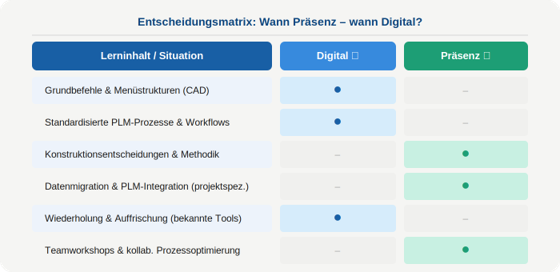
In the CAD and PLM environment, learning content can be broadly divided into two categories: content that is reproducible and standardised – and content that requires context, judgement and experience. This distinction is key to good hybrid design.
Suitable for digital delivery: basic commands, menu overviews, system logic in CATIA V5 or Siemens NX, standardised PLM processes in Teamcenter, revision units, onboarding modules. Here, e-learning is superior: scalable, location-independent, accessible at any time.
Face-to-face training required: design decisions, project-specific workflows, data migration, PLM integration into existing corporate structures, team workshops and collaborative process optimisation. These areas require direct dialogue with an experienced consultant or trainer.
Structuring hybrid learning in three phases
Successful hybrid training concepts – such as those we have been developing at ARTECH Consulting for over 15 years – follow a clear phased approach. They allocate learning objectives specifically to the relevant learning format, rather than mixing formats at random.
Phase 1: Digital Preparation (Pre-Learning)
Before the face-to-face session, participants learn at their own pace: basic commands, interface logic, core workflows – everything that can be taught in a standardised way. This has two key advantages: the group arrives at the course with a consistent level of knowledge, and valuable face-to-face time does not need to be spent on the basics.
As we described in the first part of this series, experience shows that this approach reduces face-to-face time by up to 30 per cent – without compromising learning outcomes.
Phase 2: Face-to-face training with a lasting impact
The face-to-face session is not a refresher course – it is where real skills are developed. Here, company-specific workflows are practised, mistakes are made in a safe environment and corrected immediately, engineering decisions are discussed, and PLM integrations are run through in a real-world project context.
Well-designed face-to-face sessions in engineering consultancy do not rely on lecture-style teaching, but on guided practical work: trainers and users work together on specific tasks – closely mirroring real-life project situations.
Phase 3: Digital follow-up (post-learning)
After the face-to-face session, forgetting sets in – unless you do something about it. Digital follow-up modules help to consolidate what has been learnt: short revision sessions, reference documents and exercises to be completed at your own pace. Particularly in the CAD and PLM environments, this transfer into day-to-day work is crucial for sustainable process optimisation.
Common mistakes when combining approaches – and how to avoid them
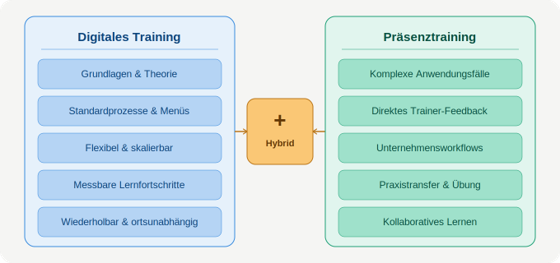
The biggest weaknesses of hybrid approaches do not stem from poor content, but from incorrect allocation.
- Too much face-to-face time for standard content: When basic commands in CATIA V5 are explained in group lessons, but participants have varying levels of prior knowledge, the group wastes time. A better approach: digital learning in advance, individually at one’s own pace.
- E-learning for overly complex content: Data migration, PLM integration or company-specific process consultancy cannot be squeezed into a self-study module. On-site engineering consultancy is required here.
- Lack of connection between the phases: If the content of the online module and the face-to-face session do not build on one another, no learning progression is created. The three phases must be designed as a single unit.
- No transfer to everyday work: Without targeted follow-up and practical application tasks, even the best face-to-face training will come to nothing. Sustainable CAD training does not end with the final day of face-to-face sessions.
Scaling hybrid concepts internationally
For globally operating industrial companies, the hybrid approach offers another key advantage: it can be scaled internationally. Digital training modules can be used across different sites – in German, English or other languages – whilst face-to-face sessions can be held specifically where project-specific expertise is required.
ARTECH Consulting GmbH supports companies with precisely this task: from conception and the development of digital learning modules right through to the international roll-out strategy – for CAD training as well as for PLM training and engineering consultancy projects worldwide.
Conclusion: Combining methods
Hybrid learning is not a format – it is a method. And like any method, it is only effective when applied consistently.
Combining face-to-face and digital formats in the technical sector works best when:
- the content is carefully allocated across the formats according to learning objectives,
- the three phases (preparation – face-to-face – follow-up) are developed as a coherent concept,
- company-specific processes, PLM systems and project realities take centre stage during the face-to-face phase,
- and the transfer into everyday working life is actively supported through digital guidance.
Well-designed hybrid learning is not a compromise between quality and efficiency – it is both at the same time.