
 Deutsch
Technical knowledge cannot simply be transferred. Anyone who trains designers, engineers, or CAD users—whether in CATIA V5, Siemens NX, or other systems—knows that understanding alone is not enough. Skill comes from practice, repetition, and concrete feedback. At the same time, pressure is mounting on industrial companies worldwide to make their training programs faster, more flexible, and more cost-effective.
Hybrid learning combines e-learning with traditional in-person training—and promises the best of both worlds. But what does this really entail in an engineering context? And where do digital learning formats reach their limits?
What is hybrid learning in engineering?
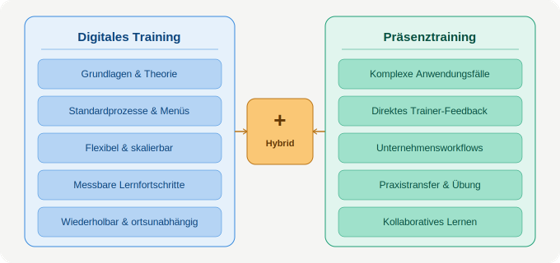
Hybrid learning combines digital learning formats with targeted in-person sessions. In a technical context—such as CAD training, PLM implementations, or engineering courses—this means, specifically, that fundamentals, concepts, and system logic are taught online via videos, interactive modules, or web-based learning platforms. Complex use cases, company-specific workflows, and direct interaction with the trainer, on the other hand, take place in person.
This model is not a compromise. It is an intentional division of learning objectives to the most suitable teaching format—and thus a central component of modern engineering consulting and training solutions.
Strengths of digital training in the CAD and PLM environment
Digital learning formats offer clear advantages—especially where content needs to be delivered in a standardized and scalable manner.
Flexibility and global scalability: Employees learn when it fits their daily work routine—whether at the Cologne office, in production in Southeast Asia or from home office. Once created, CAD training modules can be used for any number of learners worldwide without additional trainer effort.
Repeatability: An e-learning module explains the same process with consistent precision every time. Anyone who does not quickly grasp a function in CATIA V5 or Siemens NX can repeat the module as often as needed—a limited option in a classroom setting.
Measurability and process optimization: Digital learning platforms automatically track learning progress. Engineering departments can precisely survey who has completed which modules—and where targeted refresher training is needed.
In the field of CAD consulting and PLM training, digital formats are especially well-suited for teaching basic commands, system logic, data structures, and standardized processes—for example, during the implementation of Teamcenter or other PLM systems.
Where digital engineering training reaches its limits
Teaching technical skills involves more than just explaining click paths. Notably, in complex digital engineering environments a well-made video is not enough.
Lack of interaction: Constructive decisions often arise through dialogue. “Why was this modeling approach chosen?” or “How do we solve this PLM integration in this specific project?”—such questions cannot be asked in a course video. Hybrid learning only works well when in-person sessions are deliberately used for precisely this kind of interaction.
Knowledge transfer is not automatic: Knowing something and applying it are two different things. E-learning modules can demonstrate how a function works. Practicing under real-world project conditions—with one’s own mistakes, direct feedback, and concrete engineering situations—requires guided practice sessions with experienced consultants.
Technical complexity requires context: Those who work daily in CATIA V5, Siemens NX, or Teamcenter encounter situations that no standard course covers. Company-specific configurations, data migrations, and PLM integrations can only be represented to a limited extent in generic learning paths—this is where tailored technical consulting is needed.
Case Study: CATIA V5 Implementation with a Hybrid Approach
A medium-sized mechanical engineering company introduced Siemens NX as its new CAD platform. Instead of a traditional one-week training session, the company—supported by experienced CAD consultants—opted for a hybrid model: The basics and operating principles were taught in advance via self-paced e-learning modules, while the in-person training days focused exclusively on company-specific workflows, troubleshooting, and applying the knowledge to real-world projects.
Result: In-person training time was cut almost 30 percent. Users entered the course with a uniform level of knowledge, making group work and the whole implementation process a lot more efficient.
Conclusion: Hybrid learning requires smart design
Hybrid learning in an engineering environment works—if well-thought-out and tailored to the company’s specific requirements. The crucial question is not “Online or in-person?” but rather “Which learning objective can I best achieve using which format?”
- Digital formats (e-learning): ideal for standard knowledge, scalable CAD fundamentals, and PLM system logic
- In-person phases: indispensable for practical application, engineering consulting, and company-specific processes
- Hybrid combination: more efficient, sustainable, and flexibly scalable—both internationally and locally
For industrial companies in the engineering sector, this means: Investments in hybrid training concepts pay off when closely tailored to the company’s own systems, processes, and project goals and supported by experienced CAD and PLM consultants.